Physiological Amenorrhea
(Loss of Periods due to Normal Causes)
Written by Dr.M.D.Mazumdar, MD
Physiological amenorrhoea (loss of periods) or natural amenorrhea refers to the absence of menstrual periods that is due to a normal bodily function or process, such as pregnancy, breastfeeding, or menopause. This type of amenorrhea will be discussed on this page.
Causes of Physiological Amenorrhea
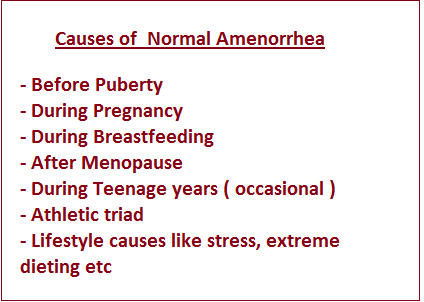
Causes of Normal Amenorrhea
- Before Puberty
- During Adolescence / Teenage years
- During Pregnancy
- While Breastfeeding
- During Menopause
- Lifestyle Causes : Sometimes, stress, emotional disturbance, changes in the exercise and diet can caue amenorrhea. Reversal of these issues can help restart teh menstrual periods.
- Athletic triad : The female athlete triad is defined as the combination of disordered eating, amenorrhea and osteoporosis. Female athletes who engage in intense physical activity and restrict their caloric intake may suffer from loss of periods as a result of low body weight and reduced fat stores which leads to low estrogen levels.
- Medical history: A thorough menstrual history must be taken including the , age of onset of menstruation, regularity of the periods and any recent changes in menstrual patterns. This will help identify any hormonal imbalances which could be the cause of the amenorrhea.
- Physical examination: A physical examination may show signs of pathological conditons like hypothyroidism, hyperprolatinema, and PCOS. A pelvic examination to check for any structural abnormalities in the reproductive tract, including uterus and ovaries are necessary.
A pregnancy can also be diagnosed by palpating the uterus for its size.
- Laboratory tests: A urine test is mandatory to rule out or confirm a pregnancy. Other necessary tests are blood tests to measure the levels of estrogen, progesterone, follicle-stimulating hormone (FSH), luteinizing hormone (LH), TSH and prolactin.
- Ultrasonography : An ultrasound may be needed to check for a pregnancy or for any structural abnormalities of the uterus and ovaries.
- Pregnancy and Breastfeeding : Pregnancy and breastfeeding are not conditions that requires treatment for amenorrhea but good medical support is necessary for the health of both the mother and the baby.
- Menopause: Symptoms associated with menopause like hot flashes and excessive sweating cna be treated with Hormone Replacement therapy.
- Athlete triad: Athletes must be encouraged to increase caloric intake and avoid excessive exercise to improve body weight and fat stores.
- PCOS: Treating PCOS with a combination of lifestyle changes and medication will help regulate ovulation. Regular ovulation will lead to normal and regular menstrual cycles.
- Hypothalamic amenorrhea: Treatment of the underlying cause, such as stress or weight loss, and restoring a healthy weight and eating habits can help stimulate ovulation and the return of the periods.. Hormonal therapy can also be used to regulate menstrual cycles.
- The Normal Menstrual Cycle / Period.
- Causes and Treatment of Infertility.
- Caring for a Normal Pregnancy .
- Managing Menopausal Symptoms.
Amenorrhea is normal in childhood before the onset of puberty. All women are born with a set number of eggs in their ovaries which are genetically determined. This number ranges between two million to three million.
The number of eggs degenerate and gradually decrease in number and by the time a girl reaches her first period at about the age of eleven years, she has only about 300,000 oocytes in her ovaries. Of these only about 500 oocytes are destined to develop into mature follicles during the girl's reproductive life.
Before puberty, the pituitary gland in the brain is mainly concerned with ensuring physical growth.
The cue to start the periods comes from an area of the brain called the hypothalamus.
As the girl reaches 9 - 10 years, the hypothalamus starts to secrete a special hormone called the Gonadotrophin Releasing hormone (GnRH).
The GnRH stimulates the pituitary gland to secrete hormones called Follicle Stimulating Hormones (FSH) and Leutinizing Hormones (LH).
The FSH and LH stimulate the ovaries to release an ovum ('ovulation') every month.
While most girls get their menstrual periods regularly every month once menstruation starts, regular periods may not be established till the age of 16 -18 years in other girls. This is normal and not a cause for concern. It is only when the girl does not get regular periods after the age of 18 years that she needs to be tested.
Occasional loss of periods lasting for 2 - 3 months is normal during the teen years, especially in the early adolescence.
It takes some time for the pituitary to secrete GnRH regularly.The ovaries may also need time to settle into a routine of ovulation and regular cyclical periods. Occasional Amenorrhea occurs in 10-20% of girls in their teens with no lasting side effects and no future problems with fertility.
Missing a period is one of the earliest and most reliable symptom of pregnancy.
It is also the commonest cause of amenorrhea in adult women in the reproductive age.
During normal pregnancy, large amounts of estrogen and progesterone are secreted from the chorion in early pregnancy and from the placenta after the third month.
These high levels of estrogen and progesterone suppresses the secretion of FSH and LH from the pituitary gland. Since ovulation cannot occur unless the ovaries are stimulated by FSH and LH, periods also fail to occur.
After childbirth, it becomes important for the body to nourish the baby. So the the pituitary gland concentrates on producing large amounts of the hormone Prolactin.
Prolactin is the main hormone responsible for stimulating growth of the breasts during pregnancy and for initiating and maintaining the secretion of breastmilk while breastfeeding the baby. The high levels of prolactin suppresses the secretion of FSH and LH from the pituitary gland resulting in loss of periods and amenorrhea.
The blood level of Prolactin, which is already high during pregnancy, increases sharply after childbirth. If breastfeeding is started and continued, the level remains high, preventing ovulation and menstruation. If however, breastfeeding is never started or stopped at any time, the level of prolactin decreases. The pituitary starts to secrete FSH and LH, and the menstrual cycle begins to occur again.
Loss of periods occur after the menopause. Menopause sets in during the ages of 45 to 55 years, the average being 51 years.
Menopause before the age of 40 years is rare and is called premature menopause. When the number of Graafian follicles in the ovary gets exhausted, the ovary fails to react to the circulating FSH and LH hormones secreted by the pituitary gland. As a result, the pituitary secretes more and more FSH in an attempt to stimulate the ovaries. The high levels of FSH and low levels of estrogen are the main diagnostic features of menopause. The main diagnostic feature without blood tests is Amenorrhea in a woman for at least 1 year.
Diagnosis
An accurate medical history, blood tests and imaging tests like ultrasounds will help rule out any pathological cause of amenorrhea.
Treatment of Physiological Amenorrhea
Physiological amenorrhea is due to normal processes and do not need to be treated.
Symptoms at different stages like puberty and menopause cna be treated if they are very uncomfortable.
How can Physiological Amenorrhea be prevented?
Since this is a natural and normal process, the question of prevention does not arise.Read More:


Also Read-
Do you have a gynecological or obstetrical problem? Would you like to discuss it in private? Consult our online gynecologist Dr.M.D.Mazumdar, MD (O&G), at any time you want and get your reply within 24 hours.We charge a nominal fee of USD 20 ($20) per question through Paypal.com.
The procedure of asking a question is quite simple. Clicking on the link below takes you to the Paypal website where the payment is made. After the payment goes through, you will be directed back to this website where you can ask your question. And rest assured, you will get your answer within 24 hours. And usually, even sooner.