The Female Breasts
Written by Dr.M.D.Mazumdar, MD
The female breasts or 'mammary glands' are also called the accessory reproductive organs. Although they are not directly involved with pregnancy or childbirth, they nevertheless play a vital role in the growth of the baby after it is born.
During childhood, the breasts in a young girl consists of a simple system of ducts and are not very different from the breasts of a young boy.
Breasts start to develop from about the age of 9 - 10 years just before the onset of the first menstrual period, under the influence of hormones from the adrenal cortex as well as by estrogen and progesterone secreted by the ovaries.
Fat is deposited around the acini to produce the typical rounded shape of the breasts.
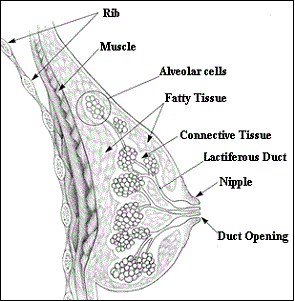
Each breast is divided into 15 - 20 lobes separated from each other by fat. Each lobe is again divided into lobules that are made up of masses of alveoli clustered around the ductules. The milk is collected from each alveoli by these fine ductules which join each other to form a single larger duct called the lactiferous duct. Each lobule is drained by a single lactiferous duct.
Thus, each breast has 15 - 20 lactiferous ducts which drain the milk towards the nipple. Behind each nipple, the duct dilates to form the ampulla where the milk is stored. This milk is released through the lactiferous openings at the tip of the nipple at the time of suckling of the baby.
Areola of the breast
The areola is a pigmented area about 2.5cm in size placed at the center of the breast. It contains numerous sebaceous and sweat glands which keep it well moisturized. Along the edge of the areola as well as on the nipple itself are specialized sebaceous glands known as Montgomery's tubercles. The glands secrete a oily liquid to keep the areola and the nipple lubricated and protected. They become more prominent during pregnancy. Montgomery's tubercles number between 4-28 on each breast.
Breast Nipples
The nipple is a pigmented projection in the center of the areola accommodating the 15 to 20 lactiferous ducts and their openings. It contains erectile muscles which causes the nipple to become erect on stimulation. Although the breast is embedded in fat, there is no fat under the areola or nipple.

The adult female breast is supported by fibrous tissue which fixes it to the pectoral muscles on the chest wall below it. Thin strands of fibrous tissue also extend forwards from the breast to the skin.
Size of the Breast
The size of the breast depends to a large extent on the amount of fat surrounding the lobules. So a large-sized woman may have larger breasts than a thin woman.
Since the ability of the breast to secrete milk depends on its lobules and not on the fat, the size of the breast has no relation to the amount of milk it can produce during breastfeeding.
Breast Changes During the Menstrual Cycle
The breast tissue undergoes cyclic changes in response to the level of estrogen and progesterone secreted during the menstrual cycle.
In the early part of the menstrual cycle, the level of estrogen rises, causing some amount of enlargement of the breast ducts. In the later part, just before the menstrual period, the high level of progesterone causes the enlargement of the alveolar cells.
These changes may cause enlargement and tenderness of the breasts just before the menstrual period. This is more commonly seen in women who suffer from premenstrual syndrome(PMS) and in a condition known as fibrocystic disease of the breast.
The tenderness and the enlargement decreases once the menstrual period begins with the fall of the hormonal levels.
Breast Changes During Pregnancy
During the early pregnancy, the breast ducts and alveolar cells begin to develop and grow under the influence of a hormone called prolactin secreted by the pituitary gland. More fat is deposited around the cells.
The areola becomes more pigmented. A surrounding area of pigmented cells called the secondary areola may be seen in the second trimester of pregnancy. The nipples also become darker and more prominent. Fine veins may become prominent on the surface of the breast.
In the third trimester of pregnancy, the breasts may secrete a thin liquid called colostrum. Colostrum secretion usually occurs on squeezing the breasts, but may also occur spontaneously.
After the childbirth and when breastfeeding starts, the breasts may increase even more in size. Complications like breast engorgement and breast abscesses can occur at this time.
Breast Cancer
Breast Cancer can develop at any time in a women's reproductive life, although some types of breast cancers are more common after the menopause. Mammographies should be done every 2 years, especially in women who are at risk for breast cancer.
Read More:


Also Read-
- Caring for the Normal Pregnancy.
- Menstruation/Period and Why it Occurs.
- Vaginal Discharge with Itching .
- Causes and Treatment of Infertility.
Do you have a gynecological or obstetrical problem? Would you like to discuss it in private? Consult our online gynecologist Dr.M.D.Mazumdar, MD (O&G), at any time you want and get your reply within 24 hours.We charge a nominal fee of USD 20 ($20) per question through Paypal.com.
The procedure of asking a question is quite simple. Clicking on the link below takes you to the Paypal website where the payment is made. After the payment goes through, you will be directed back to this website where you can ask your question. And rest assured, you will get your answer within 24 hours. And usually, even sooner.